Bird Cherry
Prunus avium
Plant Description
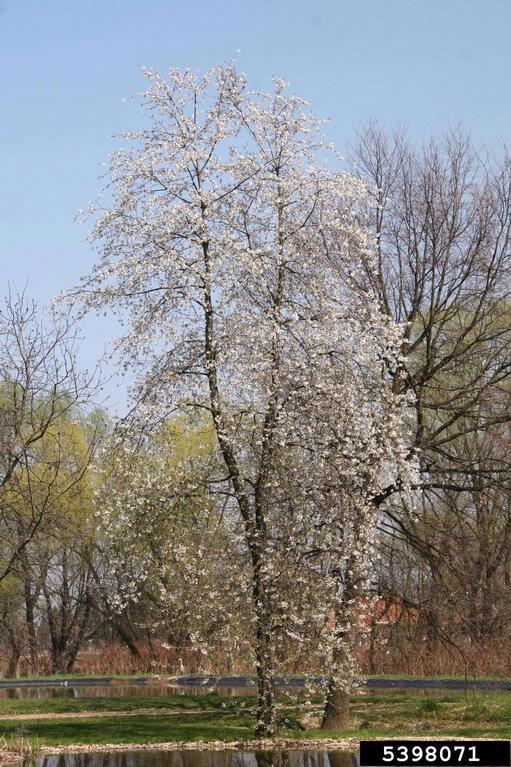
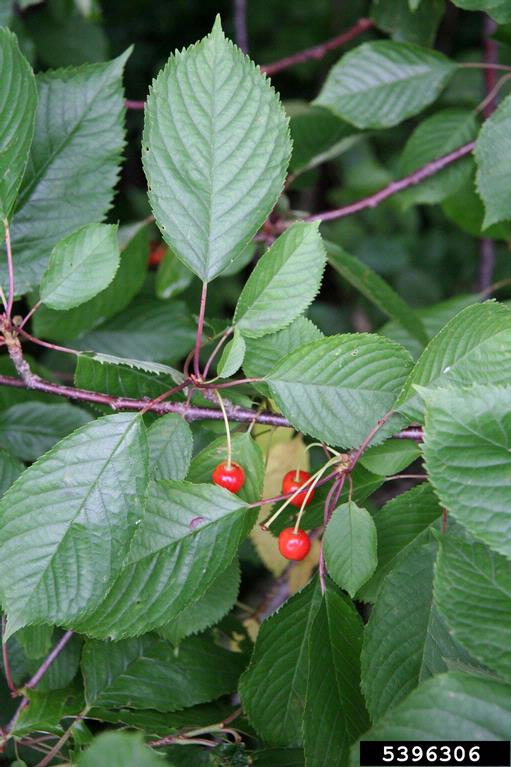
Bird cherry is a deciduous tree native to Europe and western Asia. It has many cultivars which are grown for edible fruit or ornamental purposes. It is also used as rootstock (the plant to which you graft the edible or ornamental variety you want) for many cherries. Unlike those cultivated varieties, the straight species (non-cultivated variety) of bird cherry is aggressive. It can grow 40–100 feet tall (too tall to harvest the cherries) and competes with native trees. It is recognized by its smooth, reddish-brown bark with prominent horizontal lenticels. In spring, the tree produces clusters of white flowers followed by small, tart cherries in early summer. The cherries have more pit and less pulp than cultivated cherries, though the birds eat and spread them readily. Bird cherry establishes in forests and riparian areas, where it may outcompete native vegetation. It may also hybridize with the native bitter cherry (Prunus emarginata), creating sterile, fruitless hybrids that replace the native plant and reduce the amount of fruit available to birds.
While bird cherry does produce fruit and has pretty white flowers, the fruit of the non-invasive cherry cultivars is much higher quality and easier to access. The flowers of non-invasive ornamental cherry cultivars are also more attractive and have a wide range of colors.
Plant Details
| Life Forms | |
|---|---|
| ODA Listing | |
| Soil and Moisture Conditions | |
| Suggested Actions | |
| Special Uses | |
| Shade Preference | |
| Mature Height | 40-100' |
| Distribution | It is widely distributed across the Willamette Valley and neighboring ecoregions, especially in riparian areas and forest edges, though it can grow in deeper forests. |
| Control | Pull seedlings or use a weed wrench to pull small saplings before they get large. Dig root systems of larger plants. Use cut-stump methods to prevent suckers from forming when cutting down larger trees. You can also do basal bark treatments for larger trees that you want to kill, but not remove. |
| Disposal Methods | Don't dispose of any cherry seeds in natural areas. Cut or pulled trees can be burned on site, piled into a habitat pile, or left to break down. Survey site regularly to find new seedlings before they get big. |
| Reproduction and Spread | Bird cherry is spread by birds, racoons, and other animals that eat the fruit and drop the seeds in distant areas. They frequently pop up around old cherry orchards, in forest edges, and in open woodlands. Prevent the spread by managing large bird cherry trees. |
| Introduced | Originally from Europe and western Asia, it was introduced in the 1600's for fruit and ornamental value. |
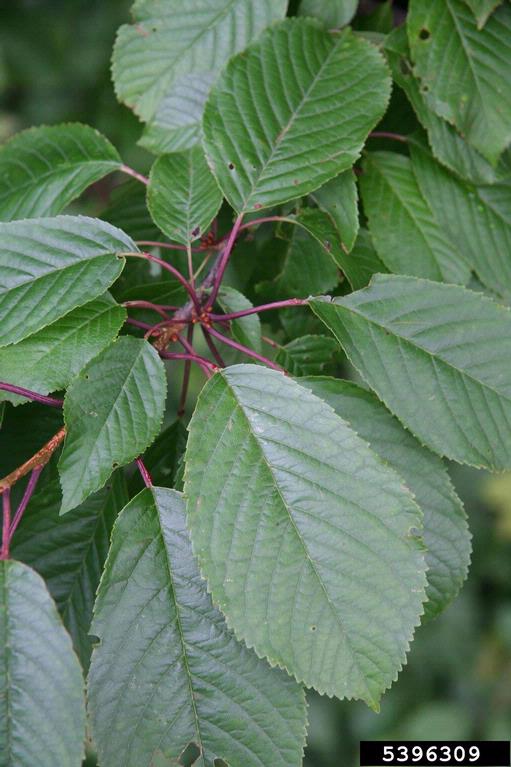
| Look Alikes | Bird cherry can be confused with the native bitter cherry and chokecherry. Both native cherries are much smaller in stature, topping out at 20-30'. The cherries of both are smaller, and in the case of chokecherry, they grow in long elongated clusters with purple-to-black fruits. Bird cherry leaves also have glands at the base of the leaf (small bumps on either side where the stem meets the leaf) that are much larger than those on the native cherries. |
| Impact | Bird cherry impacts ecosystems by forming large canopies that outcompete native plants, reducing biodiversity. They hybridize with native cherries, diluting their genetics and reducing the spread of native cherries. Birds spread the seeds into forests and riparian areas, where the shade-tolerant seedlings can form monocultures, displacing beneficial native vegetation and altering food webs for insects and larger animals. |