
Yellowbush Lupine
Lupinus arboreus


Plant Description
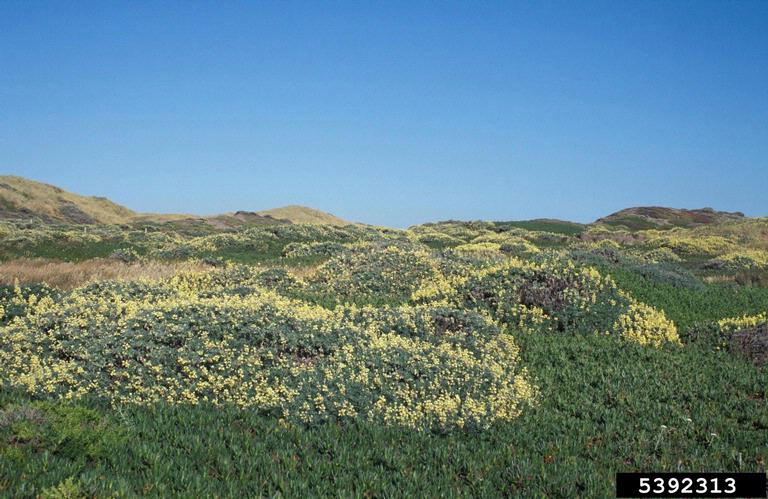
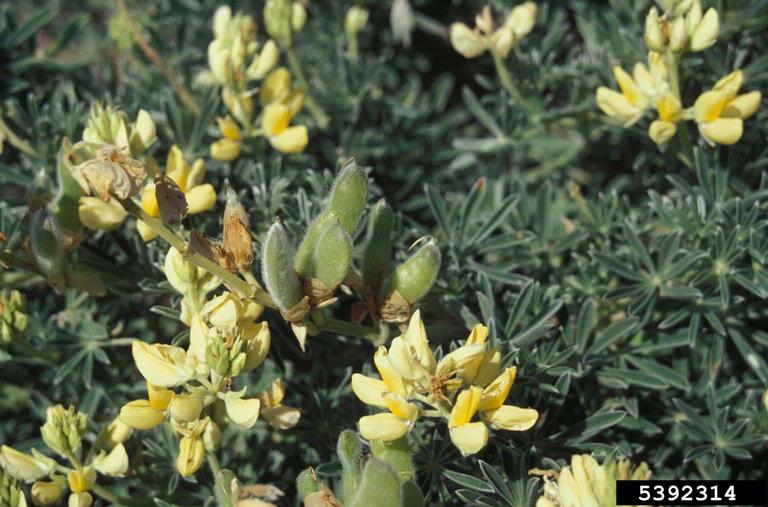
Yellowbush lupine is a fast-growing, semi-woody perennial native to coastal California, whose range may be expanding as it’s planted elsewhere for erosion control and ornamental use. It forms rounded shrubs 3–6 feet tall with palmate leaves and dense spikes of fragrant yellow flowers that bloom in spring to early summer. Like other lupines, it fixes atmospheric nitrogen through symbiosis with rhizobia, allowing it to establish in nutrient-poor sandy soils. Outside its native range, particularly in parts of the Pacific Northwest, it can naturalize aggressively and alter soil chemistry, facilitating invasive grasses and displacing native dune vegetation.
Plant Details
| Life Forms | |
|---|---|
| Habitats | |
| ODA Listing | |
| Soil and Moisture Conditions | |
| Suggested Actions | |
| Special Uses | |
| Shade Preference | |
| Mature Height | 3-6' |
| Distribution | It can spread aggressively in coastal habitats or in poor, dry, sandy soil. |
| Control | Manual removal is the most effective control method. Plants can be hand-pulled, removed with a weed wrench, or dug out, but it is important to remove the entire root system. Remove plants before they set seed, as the seed pods burst open and can scatter seeds several feet away. After removal, replant the area with native species to reduce the chance of re-infestation. |
| Disposal Methods | Plants without seeds can be dried and burned or composted on site, but seed pods should be bagged and disposed of in municipal waste. |
| Reproduction and Spread | Yellowbush lupine spreads from seeds, which are ejected from pods in late summer and can be thrown many feet from the parent plant. |
| Introduced | Yellowbush has been introduced from coastal California. |
| Look Alikes | Native lupines in our area tend to have purple, blue, or white flowers, but there are non-native, non-invasive lupines that also have yellow flowers. Yellowbush lupine also appears larger and woodier than our native lupines and most ornamentals. If the plant appears to be naturalizing (growing where it probably wasn't planted), somewhat woody, and has yellow flowers, it should be considered suspicious. |
| Impact | This lupine species can spread aggressively in coastal and sandy habitats. It outcompetes sensitive native plants and often forms dense stands dominated by a single species. It impacts soil and, like all lupines, is toxic to livestock. |